Thursday, January 31, 2013

An Intense Travel Day

See our Safari  album link at African Safari
This African safari is an organized tour. Although we have traveled a lot, the idea of Africa was intimidating, and Overseas Adventure Travel was our go-to company for this trek. The basic itinerary took us from Detroit to Atlanta, to Johannesburg South Africa, Chobe National Park in Botswana, the Okavango Delta in Botswana, Kafue National Park in Zambia, Hwange National Park in Zimbabwe, and Victoria Falls in Zimbabwe. We added an additional 6 days in Capetown, South Africa on our own with friends Gail and Janet since we were in the neighborhood, and didn't know if we would ever pass this way again. We took a total of 13 flights and about two dozen game drives, so we spent a lot of our trip in motion. The description that follows is one of several similar travel days that would have been a nightmare to arrange on our own.
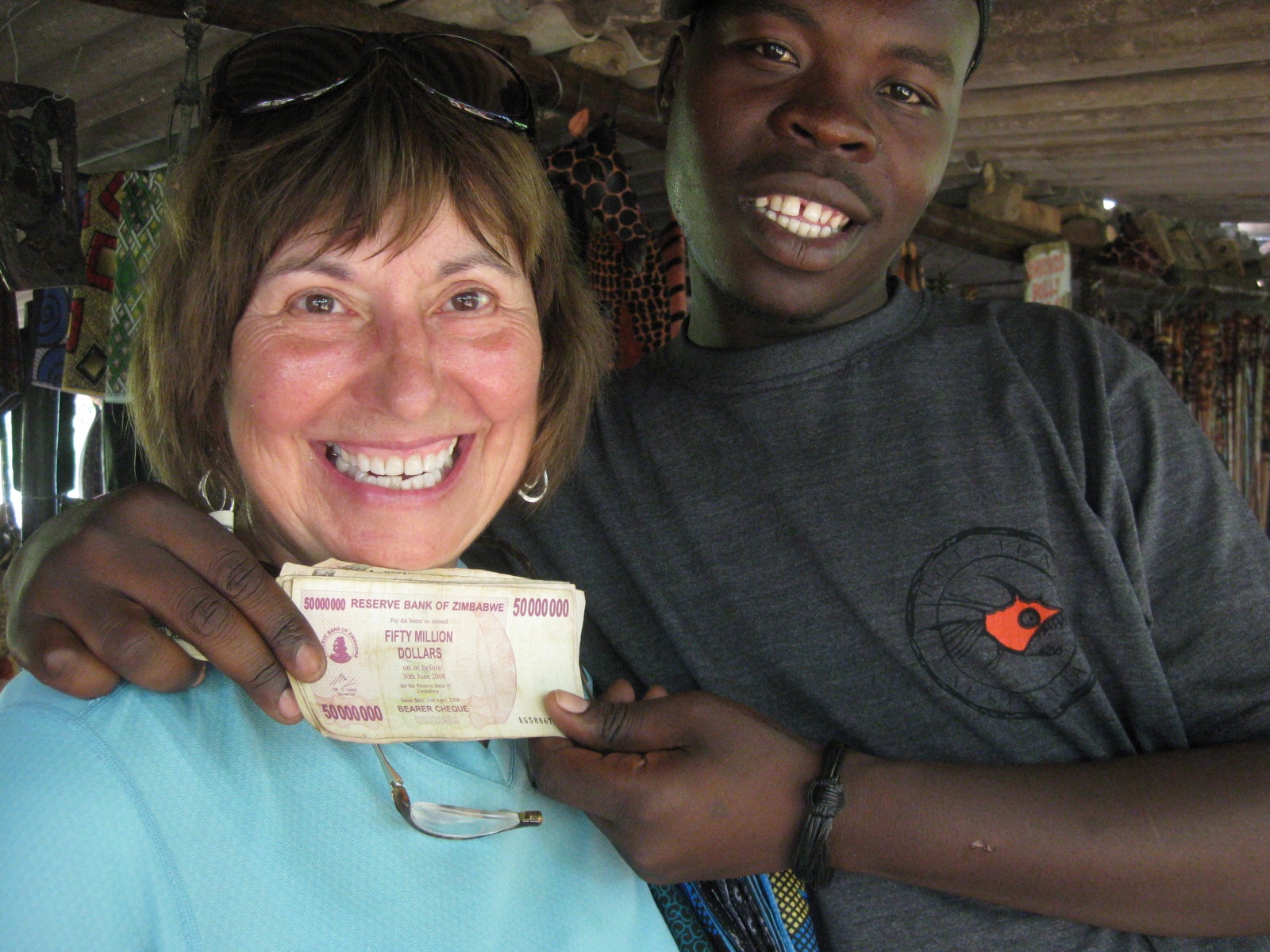
"You had me at $40 Million!"

Today our group was scheduled to switch hotels, from Banoka Camp in the Okavango Delta in Botswana, to Lufupa Camp in Kafue Park in Zambia. That sounds simple enough. It turned out to be a wild ride. We began with a very civilized 7:00 am wakeup and hit the road in our caravan of three land rovers at 8:00 am, right on schedule.  The drive to the airstrip only took about 15 minutes. We were in the third truck with six other travelers. We drove through a wet, muddy, deep boggy area that both other vehicles had already traversed. Alas, we did not quite make it through. Linda took responsibility because she had had that second piece of toast with lime marmalade for breakfast.  We bottomed out on some hidden object, and the four-wheel drive couldn't dig us out. Chief, our resourceful guide and driver, called his colleagues to help out, so Moses dropped off his passengers and parked nearby, just close enough for us to make a dry crossover to his vehicle. Whew! Problem solved! He proceeded to head towards the planes, drove twenty feet when, surprise, immediately got stuck. Sort of a vehicular Tar Baby.  A THIRD driver was summoned, looked at the vehicle full of Americans with an expression that could only be translated as WTF!!, and told us we needed to take off our shoes and walk through the muck to his truck.  We decided not to tempt fate a third time and opted to walk all the way to the plane this time.  A few moments later, slightly muddied, we were ready to board the 12-passenger plane that had been waiting for us. Oops, a slight issue....the PLANE was stuck in the mud. A little shoveling and engine revving, and we are off to Kasane airport.


Zebras on the airstrip? We never had THAT in Detroit!
 On arrival, we made a quick transfer to a minibus, and drove to the Botswana exit border, where our papers were checked and we were permitted to continue a few miles to the Zambia entry point. Most African land borders are set up this way, with a country exit, a "no man's land", and a country entry. Thank goodness that we had Wallace, our trip leader, handling our visa applications.  We never left the bus.  He bundled up our passports, collected our fees, and turned them in wholesale to the immigration office.  We were given our entry visas and admitted into Zambia sight unseen. Roger was appalled. What kind of security is THAT? The area was very intimidating, full of trucks, people, touts selling everything, and it was a wonderful thing to NOT be on our own. Group travel can be a great thing!


Here's the plane; now will we actually fit inside?

A short drive later, we hopped off the bus and onto a ferry that crossed the Zambezi River, then onto another bus for an hour-long ride to the Livingstone airport, where we were rushed to our departing flight. This time, we boarded a 4-passenger plane for the hour and half ride to Kafue Park, landing on a gravel airstrip in the forest. A 15 minute land rover drive brought us to the Lufupa Camp, where we were greeted by the staff playing drums, dancing, and singing. You know how restaurant staffs sometimes sing a dismal version of "Happy Birthday"? Well imagine that the waiters, busboys, chambermaids,and dishwashers are concert-quality singers and dancers, and look happier than Disney World employees. It was impressive. A welcome drink and snacks (we are not talking Doritos and carrot sticks but wood-fired pizza and chocolate brownies) were served by staff that immediately learned our names (which is more than we can say for some of our fellow travelers) , and we lounged on the deck overlooking the Kafue River, where hippos and crocodiles live.

We had an hour or so to relax before supper and a night drive, similar to deer-spotting in northern Michigan, except we didn't have an open beer between our legs;  it is legal; and you see hippos in the woods. We were quite astounded to see an enormous hippo cross the road in front of our vehicle and disappear into the woods. How, in God's name, did he fit his two-ton body between those densely packed trees? I guess when you are that big, you blaze your own trail every time you move. Our bedtime orientation talk stressed that we must never walk at night, since the predators are active and there are no fences to keep lions, crocodiles, leopards and the like away from the camp. Hippos can roam up to 20 miles away from the river at night to eat, have a top running speed of 40 mph, and are the leading cause of animal-related human deaths in Africa. It seemed prudent to follow the rules since our plan was to return home alive. We had a long, extremely tiring day, and we were very ready for a good night's sleep. Tucked in under our mosquito netting, we felt secure until about 2 am, when we were awakened by 2 hippos eating grass just beyond our tent's deck..about 10 feet from our not-so-secure, lightweight, non-locking screen door. It was a thrilling reminder that we're not in Allen Park anymore.
 
Next Post:  Animals of Africa


Pretty sweet accomodations for a "tent"!


Sunday, January 27, 2013

This is Africa


As I begin to write this, I must tell you that I am looking across a pond at a father and three baby ostriches eating and drinking at the edge of the pond. Flocks of birds are flying, and dozens of termite mounds are poking out of the grass, like small monuments at an overgrown cemetery.  Everyone else in camp is having a siesta, so I am alone on the open deck of the lounge with my feet on a table, sipping a cold drink. Heavenly.

 We are in Africa. The trip here was painless, as painless as 22 hours of travel can be. We all had aisle seats, decent food, and many, many movies to choose from. The one crying baby was more whiney than screaming, and we hardly noticed him after the first hour or so.  We arrived Sunday afternoon and  spent our first night at a charming hotel with excellent food and a lush garden. Roger attempted to go for an early morning stroll, but was advised not to leave the grounds. He explained that he had no money, so robbery would not be an issue, but out host explained that people would kick him since he was a foreigner. Good to know. He showed his maturity by NOT going out. Way to go, Rog! We have met an interesting man who went to Nepal in his 20's and never left...he's been there 30 years, and he and Roger shared memories of the hippie cafes from the 70s. He's in Africa visiting his wife, a physician in Madagascar, before he heads back to work. Fascinating.

 We transferred hotels to meet our tour group, and spent out first afternoon on a tour of Johannesburg and Soweto, a township where 3 1/2 million black citizens were forcibly relocated in the 1970's, and has since become a city in its own right. Jet lag and a historically confused  tour guide made it less interesting than it should have been (or, as Roger says, more interesting).  We did wave to Nelson Mandela, who was recuperating at his home. I am pretty sure I saw him peeking out an upstairs window when we shouted to him. I think he waved back.

Our group tour, Ultimate Africa, focuses on staying in tented lodges and seeing African wildlife, so it seems like a good idea to give you a snapshot of a typical day. With few exceptions, ALL of our time here is similar to the day we'll outline here.


View from Camp
Wake-up calls have either been drumbeats or a cheery "Good morning, tent three!", and have usually been at either 5:00 or 6:00 am. A half-hour later is continental breakfast at the main lodge, and a half-hour after that we board the Land Rovers. The trucks have two or three rows of tiered seating, a canvas roof, and open sides, all the better to see the animals. Our driver/guide changes every day as do our seats, so we get as much variety as possible with our vantage point and with the expertise of our guide. We drive for hours over a maze of roads through woods that sometimes look a lot like the Upper  Peninsula of Michigan, minus the pines. There are other stretches that look surprisingly like golf courses, with widely-spaced trees, shrubs, sand traps, and water hazards that have hippos instead of geese. Some of the landscapes look like farmland that has been abandoned is is covered with small trees that appear to be poorly pruned orchards.  That is done by the local elephants who eat the sides and tops of small trees, giving them a stunted look. Other areas are filled with the trunks and branches of huge fallen trees that the elephants have uprooted so they could eat their delicious leaves when other food was scarce. What has amazed us is the variety of landscapes and the lack of the typical African landscape imprinted in our brains by old movies: vast plains of  golden grasses or dense jungle with Tarzan -sized vines. I'm sure that they are here somewhere, just nowhere we have been.


 After a few hours of driving, seeing animals, and "learning and discovering", we stop for a short break. Men and ladies have separate bushes to use the "loo with a view", and the guides set out coffee, tea and cookies. Then, back into the vehicles until we return to camp about for brunch at about 11:00 am, followed by siesta until 3:30 or so. High tea is at that time, and we relax with snacks and beverages while we get a lecture by one of the guides about pertinent topics. Then, we clamber back into the vehicles for another game drive. During the game drive, we stop for a "sundowner", beer, wine and cookies.

The roads deserve some description. Nearly all are two-tracks at best. One park had put in gravel roads a couple of years ago when they built the gravel air-strip. Many of those roads are impassable at time of high rain, such as right now. At one point, we drove down a deeply rutted gravel road and it disappeared directly into a wide, swift river that had a small set of rapids, followed by a road coming out on the river's other side. Isaac, our guide, laughed and said in his James Earl Jones voice, " Those rapids are really the bridge on this road. Maybe we will not go this way today."  Good call, Isaac.

Because we are here during the rainy season, many of the roads are extremely muddy and rutted. Others are completely submerged, and driving down them gives us the feeling that we are driving down a river, or through a large pond. One group was stuck twice in one day. At one point, they all had to get off of the truck in the dark while Wallace, the trip leader, cut tree limbs with a machete to stick under the offending tire until they were able to finally move. One expression we have heard often here is, "This is Africa", which explains everything from the impassable roads, to intermittent electricity, to cool hot water, to huge changes in travel itineraries. The group traveling immediately before us missed 3 days in one of the parks because it was too wet to fly, or, more accurately, too wet to land.  One must be flexible here or it may not be a pretty picture.

Dinner is Served
When the afternoon game drive is finished, dinner is served. Like all the other meals and snacks, the food is plentiful and delicious. As tired as we are, I fear that we aren't burning off too many calories bouncing on the seats in those trucks. All of the lounge and dining areas at the places we have are open to the outdoors, and every lodge has had stunning views. By the time dinner is finished, Wallace gives us a schedule for the next day, and we make our way to our tent. Of course it isn't safe to walk without an escort to protect us from the animals. In Zimbabwe, they are armed with rifles with ammo the size of chunky dry-erase markers ( obviously a teaching reference). We head off to bed, usually too tired even to read. We climb under the mosquito netting, cover up with the warm blankets (yes, we are in Africa in the summer, so cool weather just doesn't seem right, does it?) and pass out. That wake-up call comes before you know it!

Saturday, August 11, 2012

Quito, Galapagos, and End of the Road

See our Quito-Galapagos album at
Quito-Galapagos Album#
Ecuador has been the subject of much travel buzz for the last year or so as "The new Costa Rica"--beautiful, cheap, exotic, hospitable, and expat-friendly.  We saw none of that.  For us, Ecuador was Quito as a jumping-off point for the Galapagos.  Ecuador needs a second visit!

Quito
Quito, a lesser prize of Spanish plunder, is a modern city with a colonial core (like Lima and Cusco).  We stayed in the modern financial district, though, which was pretty much closed up for the weekend when we arrived.  The blowing litter and shuttered store fronts made us think of home; it looked sort of like Detroit, but with fewer wig shops.

We met our guide, Roberto, who would shepherd us through our week in Ecuador, and Sylvia, who would show us around the Quito portion.  Roberto gathered us together in a hotel meeting room for our orientation get-together. Sandy was feeling a bit puny, though, and didn't attend.  We didn't know it then, but an emergency room visit with an IV antibiotic drip was in her immediate future.  Roberto lacked the optimistic enthusiasm of Pavel in Peru, but he was a serious man with a great sense of humor--a wonderful combination.   He was a university-trained  experienced naturalist and third-generation Galapagan--just the sort of expertise we would need in the Archipelago.  But Quito?
Sylvia: Cute as a guinea pig!
But we had Sylvia!--young, bubbly and and effusive, passionate about her city, and cute as a guinea pig.  Roger wanted to put her in his pocket and take her home with us. Linda said no. She handled the goofy gringo tourist portion in Quito while Roberto took care of more serious business, like taking Sandy and big sister Linda to the clinic, arranging for hotel doctor visits, scouring the city for pharmacies in the middle of the night--that sort of thing.

We visited the Middle of the World, sort of a geographic Disneyworld just outside of Quito. It sits squarely on the Equator (marked with a prominently painted red line, so you can't miss it), and we were treated to all manner of physical demonstrations of equatorial oddities. There was a cultural element, too, like the shrunken heads.  We saw a mummified sloth head (see album) and then the park guide displayed a wooden box, from which he removed with great solemnity a shrunken human head of a long-dead native chieftain.  "But you cannot take pictures," Sylvia warned us.  It was out of respect, the park guide said.  We're not making this up.  Roberto watched the whole circus with detached bemusement.  His feet might have been in Quito, but his heart was in the Galapagos. 

The Galapagos

Our Galapagos portion of the trip began with an early morning flight. Service was quite wonderful, with Roberto handling our bags and even our boarding passes. By this point we had become well-trained group travelers dependent on our leader, much like a group of three-year-olds,"What are we doing today? What should we wear? What's for dinner? Is it bedtime yet?" Docile, but not totally tamed.

By lunch, we were aboard the Tip Top II, a small ship built to hold exactly 16 travelers. Our routine aboard the ship included fine food and two or three excursions daily. The ship's two zodiacs would ferry us to shore for hikes, or to various rocky reefs for snorkeling. We were busy and active, but had plenty of time to lounge about the ship, much like the chubby sea lions on the beach. Our Cipro consumption dropped, and everyone returned to our pre-trip levels of well-being (Welcome back, Sandy!).

The islands were astounding. This is not a terrific description, but vocabulary constraints keep us from describing them accurately. The Galapagos are inhabited by 38,000 people, but 97% of the land is a national park, under very strict control. No one may visit without a naturalist guide, and the islands are pristine. We saw other tour groups, but not many, since access to each island is strictly monitored. Animals were everywhere, and had no fear of people at all. We tried to stay the requisite 6 feet from the animals, but they were often right on the trail. Roberto knew them all, and our heads spun with the names of dozens of birds and lizards. The sea lions, giant tortoises, and absolutely precious blue footed boobies were our favorites, as you can tell from our photo album. Thank God for digital cameras. If we had been shooting photos with film we would have spent a fortune.

How was the snorkeling? Even better than the hiking. As a prelude to this, you should know that Linda is an ocean wuss. As soon as she's in water over her head, thoughts of giant squid, great white sharks, and swift undertows throw her into a near-frantic, gasping wreck. It isn't the best state of mind to enjoy an underwater experience. Fortunately for us, Roberto owns a dive shop and is a skilled diver and group leader. Confidence in him made all the difference between panic and pleasure. The animals were close to us and abundant. In addition to schools of spectacular fish, we watched huge sea turtles munching sea algae, sting rays gliding below us, and (gasp) hammerhead sharks. Linda's biggest thrill of the trip occurred when a playful sea lion swam up to her and touched her mask with its whiskered nose. Yep, she'll want to snorkel again! The only unpleasant event was Roger losing his wedding band in 35 feet of water. At least that's the story he told Linda. No ladies, he's NOT available.

We had five days aboard ship, hiking, swimming, eating, and sunning. What a wonderful way to wrap up this trip! We headed back to Quito for a farewell dinner and our flights home. Thankfully Roberto did not give a heart-wrenching speech, so we laughed instead of cried. It was an amazingly full three weeks. We made good friends, got lots of exercise, and saw sights we had dreamed of for a lifetime. What a great trip!

Coming up next January: South Africa, Botswana, Zambia, and Zimbabwe. You'll hear from us then!


Saturday, August 4, 2012

Peruvian Andes


A Post-trip Blog Retrospective: Adventures in The Peruvian Andes and the Galapagos Archipelago  in an action-packed trilogy in two parts!


We had neither time nor Internet access in South America, so we're catching up with two post-posts from the safety of Detroit, all things being relative. 

Click on our Peruvian album link at
Peru Album


We left the Amazon in the same way most intrepid explorers have departed--swarming with viruses, bacteria, and parasites.  The Amazon is an amazing ecosystem designed to consume or destroy everything that invades its turf, and we were gracious hosts; by the end of the trip we were all popping Cipro antibiotics as casually as breath mints after a dinner of roasted guinea pig. So we fourteen ticking time bombs returned to Lima, where we met Lee and Ellie, the couple from Tuscon who completed our tour group for the rest of our trip.

Our tour company, Overseas Adventure Travel, seems to be designed for Active Geezers, and they worked our asses off.  We took an early morning tour of the Incan Sun Temple, a feature of nearly every pre-Spanish Incan city, but we found it interesting in Lima because the sun rarely shines there.  The modern city was founded by Francisco Pizzaro on January 18, 1535, apparently because he liked the weather.  What he didn't realize is that the sun shines about four weeks a year (mid January to mid February, we're guessing), and the rest of the year it is dominated by a weather system known locally as garua, (Spanish for 'shitty weather').  Cool and drizzly, which doesn't seem fair for the tropics at sea level.

"I scored some fresh coca leaves..."
Roger had done his homework, and he began badgering our top-
notch Peruvian guide, Pavel, for access to fresh coca leaves. Pavel agreed that it is commonly (and legally) chewed by the indigenous population in the mountainous villages of the Andes, and its properties counteract altitude sickness, provide energy for arduous mountain hiking, and it constitutes an important part of the rural cultural heritage that we probably shouldn't miss during our Andean adventure. But in case we hadn't noticed, he kept reminding us, we were in the middle of a modern capital city. And we were at sea level.

Cusco and the Sacred Valley

Gonzalo Pizzaro: a Major Asshole
We then flew to Cusco for our Andean Adventure.  Cusco is the ancient Inca capital and is nestled in a valley at over 11,300 feet.  It was occupied by the notorious Pizzaro brothers shortly after the Conquest, and they plundered and raped and murdered with reckless abandon.  Not to be judgemental, here, but Gonzalo Pizarro, the youngest of the five, seems to have been a real asshole. 


Cusco is the jumping off point for throngs of tourists en route to the Sacred Valley and Machu Picchu--some via the four-day Inca Trail through the mountains, others by modern bus.  We were in the second group.  Our first stop in the Valley was the town of Pisac, where we arrived in the middle of a local native celebration.  As in Guatemala, their religion is a unique blend of pagan animism and Catholicism.  Our impression in Lima (and from what we had read), was that the Spanish ruthlessly crushed the native culture, religion, economy, and language.  True enough in Lima, but in the villages we realize that maybe the Spanish didn't do such a thorough job after all.  The celebration included a bizarre procession of music and dancing, with animal heads, monkey costumes, and masks with giant penis noses,  followed by a solemn float with a statue of the Virgin Mary.  Sort of like The Wicker Man meets The Song of Bernandette.  We then proceeded to the ruined Inca city of Pisac, located a couple of thousand feet above the town.  The Inca apparently built their cities among their mountain gods; the Spanish relocated them to the valleys. This was our first experience with Inca ruins, and we hiked along ancient wind-swept terraces, dodging the odd llama, with Andean pan-flute music wafting through the hills.  Pretty cool.
     We spent the night and a day at the town of Urubamba (yes, it is named for the river), where we visited a local school and had a lunch hosted by a local family.  We were served roasted cuy--guinea pig--which we believe to be  a local delicacy.  Either that, or it was the old "let's-feed-the-tourists-a- roasted-greasy-rodent-and-see- if- they-eat -it" trick.  We did.
     The next day we visited Ollantaytambo, a village as charming as its name.  We toured the ruins and astronomical sculptures in the hills above the town.  Add the glaciers shimmering in the distance, and the tableau is complete.  As great as this was, we knew it was just a prelude to the Big Banana the next day:  Machu Picchu.

Machu Picchu
Never believe the travel tales that tell you the place you are about to visit has been ruined by tourism so don't waste your time.  We have heard those tales for nearly fifty years, and if we believed them we would not have gone anywhere.  It is the most transparent form of travel elitism.  Machu Picchu was fantastic (don't waste your time, though; it has since been ruined by rampant tourism!)


The trick to our great experience at Machu Picchu had much to do with the expertise and the timing of our tour company, Overseas Adventure Travel.  We caught a narrow gauge train at Ollantaytambo, traveled though magnificent canyons along the Urubamba River, and arrived at the town of Aguas Calientes shortly after noon.  Aguas Calientes is located at the base of the ruins, which is its only reason for existence.  It is the terminus of the rail line (the only access to Machu Picchu other than hiking the Inca Trail), and it is the site from which you board the park's buses, which run in a non-stop stream up 2000 ft. of switchbacks to the park entrance.  The criticism of Machu Picchu is that it is crowded with tourists.  The truth is, they limit the number to 2000 a day, and nearly all of these are day-trippers whose schedules are defined by the rail schedule from Ollantaytambo.  We were able to arrive at the park in late afternoon, as the throngs were leaving.  By the end of day, we were nearly alone.  We spent the night in a local hotel, and Pavel roused us at 5:00 am so we could be at the park when it opened, where we saw the sunrise and enjoyed the ruins WAY before the first tourists began arriving from Ollantaytambo.  Books have been written on the beauty and engineering marvel that is Machu Picchu (and a couple of really bad movies, too.  We do not recommend The Secret of the Incas starring Charlton Heston and notable as a particular stinker.)  So we leave it to what we hope are creditable pictures on our Picassa Album (link provided near the beginning of this post).


We returned to Cusco for our last night in Peru. Pavel, our trip leader, arranged a pre-dinner debriefing session in the hotel bar. Our Arno school friends would have recognized this as a "Sue Vokal year-end staff meeting". Sue, our principal, would ask us to share our positive thoughts about the past year, which really sounds pretty harmless. The meeting would quickly degenerate into teary heartfelt soul-bearing until the staff was emotionally exhausted, surrounded by piles of soggy tissues.  How does this translate to Peru? Pavel, the most sincere man EVER, had us sniveling with his gratitude that we had chosen HIS country, of all the places on earth, to visit. By the time we finished sharing our personal memories of Peru, we were blubbering like the audience of An Affair to Remember. A box of tissues later, we had pretty much recovered, and were ready for part three of the trip, Quito, Ecuador and the Galapagos. We're aiming for fewer tears and more animals. Read our next installment to see if we accomplish that!

Coming next:  Quito, Ecuador and the Galapagos Archipelago.


Saturday, July 14, 2012

Roger and Linda in South America

Roger and Linda on the Road Again…in South America
see our linked album at Amazon#

Amazon Sunrise
Roger and Linda are back at it, on a three-week tour of the Amazon rain forest, Machu Picchu, and the Galapagos.  We're all packed up with micro-fiber travel clothes, more sophisticated electronic gear than the Mercury space missions, and we're carrying more drugs than a Detroit Middle schooler
This is our first group trip, and there is assembled here in the jungle an intrepid group of  fourteen adventurers.  There is among us a loose association of friends and friends of friends that comprise nine of the fourteen (the Michigan Mafia)—so even if the group turned out to be made up of total social misfits, we figured, they would be US.
The Cast, in order of aqppearance

The Michigan Mafia
Linda and Roger (your humble narrators)
Sandy-Linda's sister and, as it turns out, Roger's sister-in-law
Chris and Gary--life-long friends from Arizona, (formerly of Michigan)
Gail- Linda’s college roommate (with Chris) and fellow traveler
Carrie-Linda’s former colleague at Arno Elementary
Michele-Gail’s friend from Port Huron (and Roger’s former colleague)
Ellen-Michele’s friend from Port Huron

Our Fellow Travelers
Eric and Debbie, delightful couple from Staten Island—he a retired cop, she a retired school counselor.  They immediately bonded with the group and are as determined as the rest of us to suck every bit of fun out this excursion.
Nels and Tess, from Colorado---she retired last month and he a semi-retired engineer.  Nels is a real rocket scientist (No, we mean this literally.  He managed the guiding systems for all of NASA’s Mars missions.
Barb from Oklahoma—recently retired and bravely traveling singly.
One more couple- we'll meet them today.

Lima, Peru –where micro mini skirts continue to thrive
We arrived at our hotel around midnight on Saturday night, and everyone crashed immediately after a LONG day of traveling.  Except Roger, who on some flimsy pretext managed to wander the neighborhood around the hotel alone, attracted by the street bustle and the electric glow of the small casinos.  Like a moth to the flame.  Lima is home to over nine million people, many of them living in crowded, crushing poverty, we have heard.  You cannot prove it by us.  Our neighborhood is called Miraflores, a very upscale and cosmopolitan area of the city.  It is sort of like Detroit, but with clean sidewalks and throngs of well-dressed people on the streets after dark.  In case you were wondering what happened to the micro miniskirt fashion of the sixties and seventies, apparently they all migrated to Miraflores, where they host a convention on Saturday nights. Not exactly the third-world scene we were expecting, but an interesting experience nonetheless. Our city exploration time was short, but we managed to find a city park where 200+ cats are protected and fed by volunteers, a dog convention selling any clothing your shaggy pet might need, and a Zumba experience on the city streets.

The Amazon Rain Forest
On Monday morning we flew from Lima to Iquitos, a city of 700,000 in eastern Peru, deep in the Amazon basin.  Iquitos is accessible only by boat and by air (the largest city in the world with those attributes).  From Iquitos we took a boat upriver-- dodging floating tree trunks the size of, well, tree trunks--about an hour and half to our ecolodge called Exlporama.  The hotel was pretty basic—kerosene lighting in the rooms and cold showers—but the food was good and the thatched construction charming.
Our days have been packed with activities that sounded like fun, and have turned out to exceed all expectations. So far, we have fished for piranha (caught and ate some), Roger was gored by a catfish (flashback to India), we visited Monkey Island (where Carrie fell in love), hiked in the rainforest and walked the longest aerial canopy walkway in the world (119 feet high and astounding), bird~watched, saw a native shaman and got tattoos after our healing ceremony, visited a jungle clinic, went to an authentic village and market, and did a night~time boat trip (way-cool sounds!). We visited an enormous Cieba tree where our guide, Roger (yes…confusing!) promised we can swing like Tarzan, and took a night hike. That turned out to be more exciting than anticipated. We stopped walking to watch Roger (guide Roger) poke a tarantula with a stick (perfectly safe!), and those crafty fire ants saw their opportunity to chomp on North American flesh. We finished the hike, doing an ants-in-the-pants dance the whole way back, and hopping from foot to foot to prevent new one from latching on. If someone would have been filming this, it would have been the most popular viral youtube video yet. Whew…no wonder we’re tired, and that the blog is behind schedule! 

Sunday, April 15, 2012

Tikal and Near the End of the Road

(see album link at Tikal Album#
 Our last guest has left and we fly home in less than a week. Obviously, it was time for a road trip.. After much discussion, we decided on a 2-day trip to the great Maya ruins at Tikal in the rain forests of northern Guatemala. Although it was short, it was a very full two days. We left the apartment at 4:00 am for an hour-long ride to the airport in the capital. As an internal flight, the plane left from a VERY different terminal from the modern international terminal.  It was a series of rusted quanset huts on the tarmac right out of a bad fifties movie. We made it through the laxest security EVER.  The only evidence of security was a sign (in Spanish) that firearms were prohibited.  Or maybe they were REQUIRED--our Spanish hasn't improved much. They didnt even check our ID. The twin engine prop job took us to Flores, far in the north near the Mexican/Belize border, where we climbed aboard a shuttle for an additional hour- long ride to the park. We dropped off our bags at our hotel, then began our four-hour walking tour of the park with our trusty guide with the unfortunate name of Nixon. The plants, animals, spectacular ruins, and Nixon's running commentary kept us fascinated...what an amazing place!
We had a quick lunch and swim, then headed back to the ruins for a second, more leisurely look in the late afternoon. That's when we ran into a large troop of coatamundis. They were off in the distance, chattering on the road. Linda said, " Look at all those birds...no, monkeys...no, I don't know what they are." Roger countered with,"Anteaters? Maybe coatamundis?" We stopped worrying about their name as they started running toward us, and did out best to snap photos as furiously as the cameras would allow. When they got close to us, they veered into the trees and kept running until they noticed a small cistern filled with water. Suddenly, they were lined up, tails straight in the air, getting a drink. Cuter than cute. The enormous, intricate, ancient temples and pyramids had to take a back seat to cute wildlife yet again.

After an abbreviated night's sleep, we met Roxie, guide number two, at 4:30 am for a quick cup of coffee before we headed back into the park to see the sunrise. She guided us to temple 4, where we climbed many, many steps to the top, and silently sat with a handful of other tourists, waiting for the sun. On the eastern horizon we saw miles of rainforest, a handful of towering temples, and a breathtaking sunrise, listening all the while to birds and the roar of an occasional howler monkey. Perfection.

Roxie continued the tour with a detailed description of what is known about the Maya and their occupation of Tikal. She had done a number of archeological excavations at other sites in the Maya world, and knew a lot through her work and university studies. Our heads were spinning with information that we couldn't possibly retain, although we thoroughly appreciated and briefly understood it at the time. She pointed out all kinds of wildlife that we never would have seen without her expert eye. If you have a chance, find an audio file of howler monkeys. The noise is less a howl than a roar, and sounds just like a scary monster..check it out!  Roxie also gave us a lesson in ancient lime-making and food storage, so we're your go-to people after the apocalypse (remember to mark your calendars...the world ends December 21, 2012).  All in all, a terrific tour. An afternoon at the pool, meals, night flight back to Antigua, and our 2-day whirlwind was at an end.

The fun, however, was not over. Joan, our neighbor and new BFF, planned a pig roast with her Guatemalan friends Ian and Cuca on our terrace for Saturday night. Ian and Cuca had the arrangements made, so all we had to do was round out the guest list with people we sort of knew from our time here. So, Joan, Roger, and Linda boldly invited people that were our dearest Antigua friends, although many of them probably didn't quite know who we were. No matter...they all showed up, stayed the whole time, and we had a terrific time. The pig roast was spectacular. Be sure to look at the album to see to see the grill they assembled in our tiny courtyard--an engineering sight to behold. The chef was a wonderful cook, and the food was top notch. A GREAT night.

So, we are down to our last two days in town, cleaning out the fridge, buying a few souvenirs, and deciding where to eat our last meals. Not tough decisions. We plan to add one more post of a couple of photo albums that we haven't quite finished yet. Look for that in a day or few. After that, you probably won't get another post until July, when we head to Peru and Ecuador, so look for it then. Until then, adios amigos!

Wednesday, April 11, 2012

Gail's Guest Blog

(see picture album links at end of blog) 
Semana Santa
I am very happy to do this guest blog because it means I was able to partake of Linda and Roger's hospitality in this lovely city of Antigua during the most amazing time of the year - Semana Santa.  Linda met me at the airport in Guatemala City with their number one taxi driver, Kenny.  Kenny knew the shortcut back to Antigua, thereby avoiding the two hour traffic jams into Antigua, as families and visitors were arriving for Semana Santa.   Banks, schools and other businesses were closed from Wednesday through Monday.  Fortunately restaurants and stores remained open.  Linda, Roger and I, after a very good lunch at Cafe Condesa, wandered around town, looking at the alfombras, or carpets.  There are several processions every day and each has a prescribed route.  Anyone living or having a business on the route can make a carpet.  No permits are needed; there are no themes to follow nor are prizes awarded.  It truly is done as an expression of faith.  The carpets vary from a simple cross on a bed of pine needles to multi-colored ones made of dyed sawdust and decorated with flowers, mini- sculptures, animals and religious figures made from fruit and even the face of Jesus carved into the rind of a watermelon.  After the procession has passed over the carpet, city street sweepers follow and clean-up the remains.  If another procession is scheduled along that same route later that that day or the next, the families make another carpet. 

  The Procession
Every procession seems to include two floats.  The first has a statue of Jesus on it, looking to the right.  The floats are decorated anew each year, but the statue remains the same.  The same is true of Mary, who is on the second float.  The women decorate Mary's float; the men decorate Jesus'.  Included in the procession are bands, with clarinets, trumpets, baritones, tubas and drums, playing funeral-like dirges.  Jesus' float weighs 7000 pounds and is carried by 80 men, who may pay 40 Quetzales (about $5.00) for the privilege.  The tallest men carry for the first segment, usually one block, when the next group (the second tallest) takes over.  The transition is completed silently, as each carrier has been assigned numbers, indicating the corner where they begin carrying, and the exact spot on the float they are to carry.  The women carry Mary's float.  Mary's float is half of Jesus' - the cost, weight and number of carriers.  A procession may consist of 60 turns, so 80 carriers times 60 turns times many processions equals a lot of participants.  The men are garbed in purple robes and the women in black and white.  On Good Friday, after 3:00 pm both men and women wear black.  As we watched the processions, we saw fathers carrying their young sons on one arm as the other shoulder bore the weight of the float.  Likewise, with the women.  Young children also walked along side their parents, and were dressed like their parents.   Occasionally we saw someone on a cell phone and the Mahanic's neighbor, Joan, reported seeing one of the marchers snap a photo with his iPad, but generally there was a solemnity and non-commercialism to Semana Santa.  I took Elizabeth Bell's tour at 6:00 am on Good Friday, and we walked one of the procession routes, looking at over a hundred carpets.

 The Food
We have eaten delicious food here, often in a nearly empty restaurant.  Epicure and Don Martine treated us to a complimentary appetizer and dessert (tortilla soup and chocolate truffle at Epicure and eggplant ceviche and fruit platter with rum creme at Don Martine).  I took the cooking class at Pena de Sol Latino and highly recommend it, even though they did not give us aprons to wear that day.  I've taken many cooking classes and I probably did more hands-on prep than any previous classes.  I also took the class at the Chocolate Museum, where I did get an apron!  We ate at Hector's one night, which seems to be the unanimous choice as the best restaurant in Antigua.  Hector's seats 22; after a twenty minute wait, we were seated at the bar which offered a front row view of the kitchen and meal preparations.  The actual open floor space of this kitchen is about two feet by eight feet.  The head cook, prep person, hostess/waitress, dishwasher and even Hector are all in the area.  Their movements are the dance of a well-practiced ensemble, as they efficiently move in the tiny space.

 The Hiking
  On my first day we hiked to Cerro de la Cruz, for a nice overview of the city.  On Easter Sunday, we took the Earth Lodge shuttle to Earth Lodge, about a 20 minute ride, where we had understood we could hike safely.  Locals told us to avoid certain roads as the robbers are especially on the lookout during holidays.  We arrived at the drop off point, walked ten minutes uphill to Earth Lodge, only to be told that it was not safe to hike there, either.  Then one young woman said she had hiked earlier, along the same route we had just come, without any problems, but that we should probably not take our cameras because we would probably be relieved of them along the trail.  So we left our backpacks at Earth Lodge, retraced our path back to where the shuttle dropped us plus a little further, than back to Earth Lodge, where we arranged for the shuttle to take us back to Antigua.  Not quite what we had planned for the day but an interesting experience to see Earth Lodge.  Later that day, Linda and I walked through Santo Domingo, where a monastery that had been partially in ruins has been renovated into a beautiful hotel/restaurant/convention center  - it seemed the polar opposite of Earth Lodge, where (usually) younger people will go and volunteer for a bit in exchange for lodging.

The Hiking, Part II
On Monday, the tourist van picked us up at 6:00 am for the ride to Pacaya Volcano.  There were 11 of us on this bus and we were joined by an equal number at the start of the hike, led by a Guatemalan tourist guide.  The hike was advertised as an easy two hour hike.  However, for those who live in the flatlands of Michigan, it was not quite so easy, as we hiked up for over an hour to the top, which is at 8373 feet.  Accompanying us were three horses and their riders.  They kept saying to us (and by us I mean Roger, Linda and me) 'Taxi?'  I like to think we were at the end of the hikers because we were the sweepers of the hike, not because we were just a little slower than the twenty-somethings on the hike with us.  Finally Roger explained to them in his best and most polite Spanish that if he wanted a taxi he would let them know and to quit asking.  It was effective.  Pacaya was very windy at the top.  There was a small Lava Store, where one could purchase lava jewelry and other souvenirs, payable upon return to your hotel.  Our guide had sticks and marshmallows for roasting over one of the hot areas at the top.  Linda and I patiently roasted ours; Roger ate his unroasted.  Views from the top were spectacular.


Textiles
Linda and I visited the Textile Museum on Tuesday, then hit the shops so I could buy  some Guatemalan fabric.  Linda had already purchased some with Carol, and both she and I were practicing restraint as we still have yards of fabric from Bali awaiting us.  The colors are bright and lively.
Miscellaneous
 While Semana Santa (Holy Week) is a very special time in Antigua, with businesses closing for several days, it was interesting to see the places of business that remained open, including a nail salon, where Joan was able to get a manicure on Easter Sunday.
I have made very good use of my "Guatemalan wallet," which I have had for years, but was unaware of how useful it is where one must be vigilant of pickpockets, especially ones with sharp knives.  I expect to be using this wallet on future trips to South America and Africa.
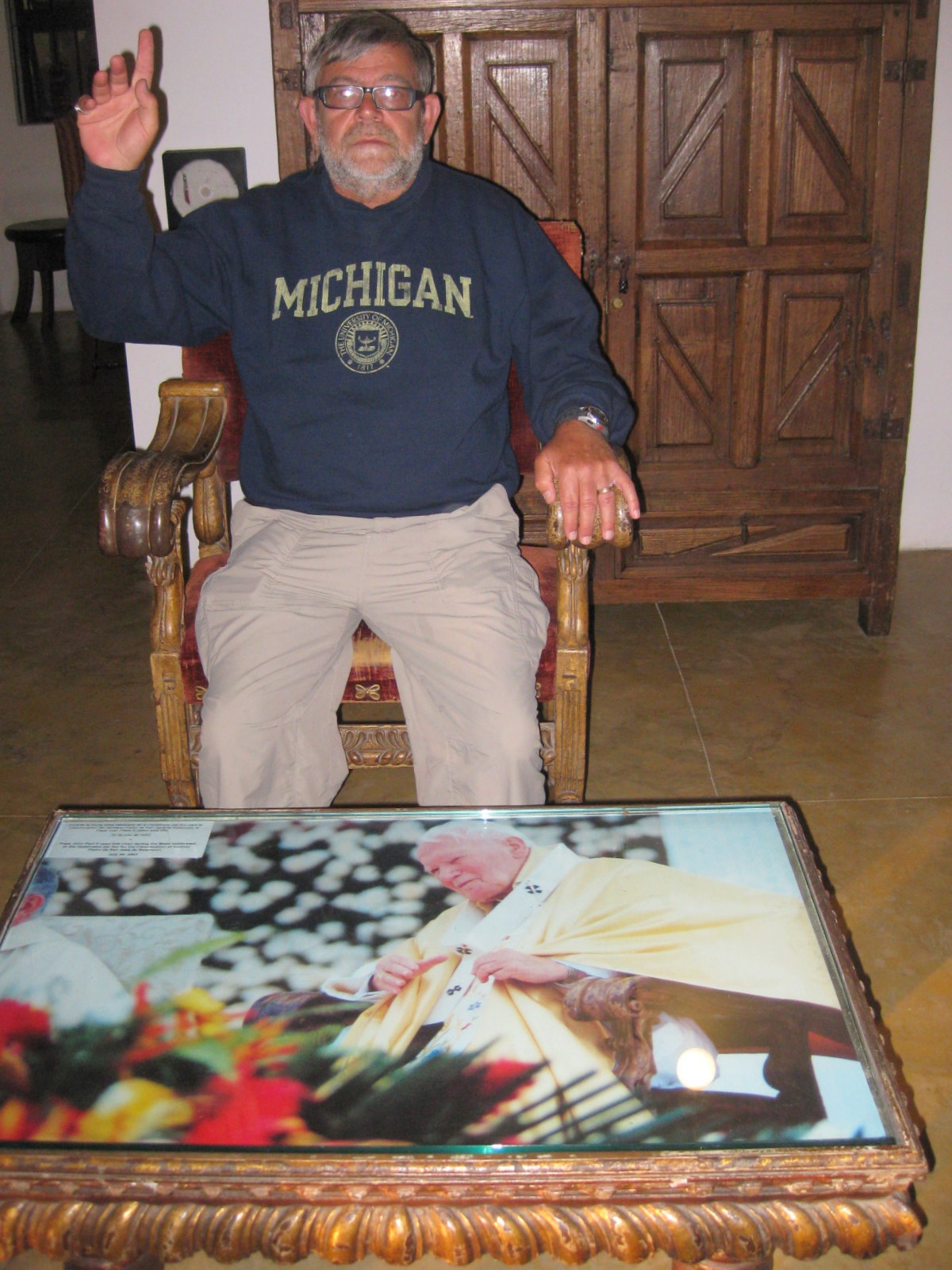
And finally, anytime Linda and Roger Mahanic invite you to join them on any adventure, just say yes.  Cancel whatever else is on your schedule, buy your ticket and be ready for a wonderful, memorable trip. (Roger sits in Pope's chair from 2002 Antigua visit in 2002: "If they didn't want you to sit in it, they'd have put up a rope or something."

Album Links:
General Pictures: Guat5#

Antigua Carpets:  Antigua Alfombras (Carpets)#

Quilt Inspirations:
Quilt Inspirations#